
Before EarthRanger, a conservation manager running a protected area was, in a sense, looking at the same landscape through a dozen different windows. Each one showing something real, none of them showing the whole picture. Elephants tracked on one platform. Lions on another. Vehicles, aircraft, rangers in the field: each with their own system, their own screen, their own data stream being viewed in isolation. You could see a lot. You couldn’t see everything at once. And in conservation, that gap, between what you know and what you can act on, is often where wildlife is lost.
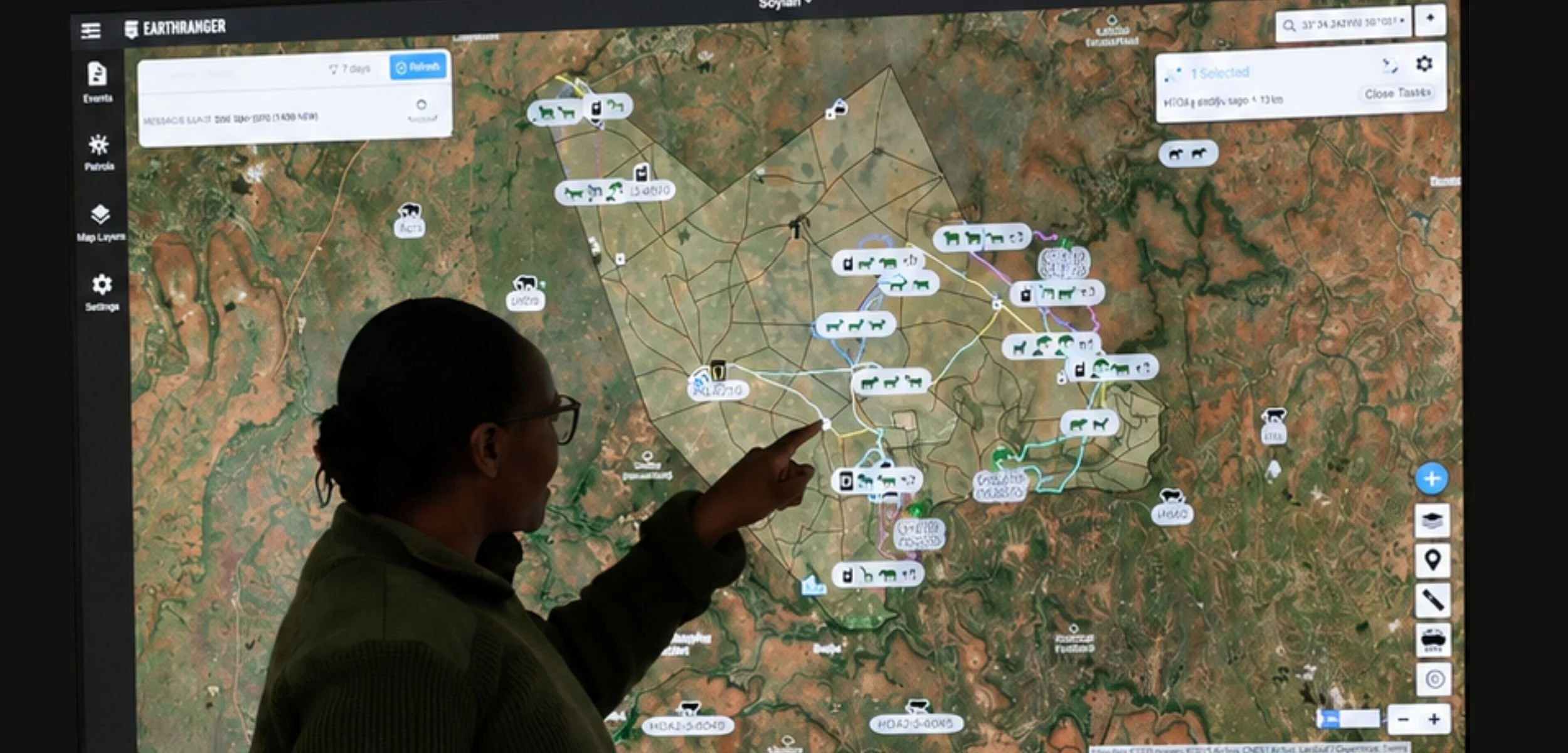
A real-time visualisation and integration platform
When EarthRanger emerged as a real-time visualisation and integration platform, pulling multiple data sources into a single, living picture of the landscape, it didn’t just solve a logistical problem. It changed the quality of decisions that conservationists could make, and how fast they could make them. Space for Giants was among the early adopters in the conservation world to recognise its significance. Maurice Schutgens, the organisation’s Conservation Managing Director, attended one of EarthRanger’s earlier partner meetings, in 2019 in Malawi, just a couple of years after the platform launched. He remembers a room of roughly forty people, from a handful of organisations. “Now,” he says, “Earthranger can no longer hold a single meeting. They need regional gatherings across the world, inviting three or four hundred people to each.” That trajectory tells its own story and the software’s success.
Space for Giants uses Earth Ranger Daily
For Space for Giants, the practical difference has been profound. The organisation uses EarthRanger daily, tracking elephant movements, logging crop raids, monitoring electric fence voltages, and keeping tabs on where rangers are deployed across vast and often remote landscapes. Data that once lived in separate systems, or not at all, now speaks to each other in real time. But what makes EarthRanger genuinely powerful, Maurice is quick to point out, is not simply that it stores information. It’s that it connects whatever technology you’re already using, satellite collars, IoT sensors, aerial tracking, field alerts, and brings it all into one operational picture. “As a conservation manager,” he says, “you suddenly have all these different data sources at your fingertips, all in one place. And that makes your decision making much more informed.”
That kind of transformation has not been limited to individual organisations. Across Africa, EarthRanger’s reach has grown to the point where entire countries have adopted it as a national standard for protected area management. Kenya and Uganda, two countries where Space for Giants has worked for many years, are among them. And the platform’s expansion has not stayed within Africa’s borders. In 2025, working alongside the Royal Commission for AlUla and Earthranger, Space for Giants helped facilitate the first deployment in the Kingdom of Saudi Arabia, bringing real-time wildlife monitoring to one of the world’s most ambitious landscape restoration programmes.
Ten years on
Ten years on, EarthRanger now supports more than 900 conservation sites across 80 countries, the result of a decade of collaboration between its founding team and the conservationists, rangers, researchers, and communities who shaped every feature it has built. Space for Giants has grown with it, not only as a user, but as an active part of that wider community, helping other organisations deploy and learn the system, building capacity across the conservation sector. That role matters to Maurice. “We’ve helped with capacity building for others,” he says, “and deployed EarthRanger for other organisations. We’re really proud of what they’ve done, and that we’ve been part of this journey.”
In conservation, a decade is both a long time and no time at all. The threats are larger than when EarthRanger’s founding team first sat down to ask how technology could help protect the world’s most threatened wildlife. But the tools available to the people working to answer that question are incomparably better. Space for Giants intends to keep using them.
